Satellite shoots geckos into space to study development in zero gravity

A group of geckos joined the 350-mile-high club for some very important reasons

Earlier this month Russia launched a satellite carrying five geckos into space to observe their mating activities in the zero-gravity conditions of Earth’s orbit. Various other organisms, including insects and plants were also placed on board for experiments. The satellite, called Foton-M, was launched on July 19th from the Baikonur Cosmodrome in Kazakhstan and is scheduled to re-enter Earth in September.

Foton_M_Satellite

The Foton-M satellite.

Last week, after making its first few orbits, the satellite stopped responding to commands from mission control, though the equipment on board was still sending scientific data back down to Earth. The biological experiment was thought to be lost, but on Saturday night communication was once again made with the spacecraft, and everything is now going according to plan. Read More

High-tech cooler pulls in millions of dollars on Kickstarter

Say hello to the 21st century cooler

Though they’re a necessary summertime item, most coolers are bulky and a nuisance to lug around on a hot day. How much better would it be if your cooler did more than just hold drinks? Inventor Ryan Grepper from Portland, Oregon plans to shed some light on that idea. He designed a new drink-carrying vessel called the “Coolest Cooler,” which took off on Kickstarter, reeling in more than $5 million from more than 21,000 backers.

Coolest_Cooler

The Coolest Cooler is anything but ordinary. It includes a USB charger, an LED light, wireless speakers, and much more.

So what exactly is so special about this super cooler? According to Grepper, it was time these things got an upgrade, and the Coolest Cooler does so much more than keep your beverages cold. It features a built-in blender, a waterproof USB charger, an LED light, a bottle opener, gear tie-down, and removable wireless waterproof speakers. Read More

Turn your iPhone into a mouse for your iPad

The TabiMouse app transforms your iPad into a cloud-based PC

If you’re an Apple aficionado with an iPhone and iPad, the free new app by Tabitop might come in handy. Called TabiMouse, the app is able to convert your iPhone into a Bluetooth iPad-friendly mouse. The only catch is you must be willing to use your iPad as a cloud-based PC.

TabiMouse_App

The TabiMouse app transforms your iPhone into a mouse for your iPad. Image via Gizmag.

How it works

Since the TabiMouse app transforms the screen of your iPhone into a laptop-style trackpad, you simply slide your finger on the iPhone’s screen to correspondingly move the cursor on the iPad’s display. Read More

Students develop robotic gardening technology to be used in deep space

In cooperation with NASA, graduate students are creating a remotely operated plant production system for producing edible plants during long-term missions

To stay healthy, astronauts have to eat a balanced diet each day while exploring beyond the Earth’s atmosphere, and right now, NASA researchers are designing robots to tend gardens in deep-space habitats. Though it sounds like a concept straight out of Star Wars, a team of graduate students from the University of Colorado Boulder is developing the innovative technology to make it happen.

The students’ entry in the eXploration HABitat (X-Hab) Academic Innovation Challenge, a university-level project designed to engage and retain students in science, technology, engineering, and math is called “Plants Anywhere: Plants Growing in Free Habitat Spaces.” They’re currently developing a Distributed Remotely Operated Plant Production System, known as DROPPS, which is a concept for producing edible plants during long-term missions to destinations such as Mars. Instead of an area set aside to be used for just vegetation, the idea behind the project is that plants will be able to be distributed in any available area in a deep-space habitat.

SPOTS_Space_Gardening_NASA

University of Colorado Boulder graduate students Heather Hava, left, and Daniel Zukowski, second from the left, describe a computerized SmartPot, or SPOT. Image via NASA. Read More

Robot responds to complex commands

The “Tell me Dave” robot learns when people talk to it

The idea of talking to a machine as if it’s human is becoming reality. Though some robots can already follow verbal instructions, they must first be programmed with software code that allows them to respond in a predetermined way. But wouldn’t it be easier to avoid all of that and just be able to explain what you want a robot to do?

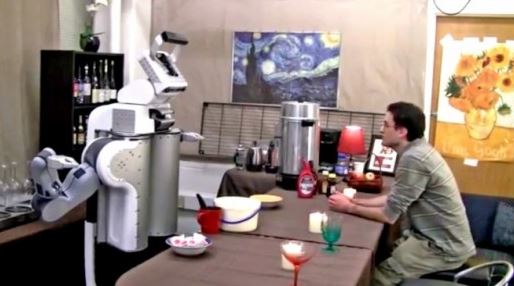
A new research project is focusing on doing just that. At Cornell University, a computer science team designed and built a learning robot as part of their “Tell me Dave” project. The Tell me Dave robot is based on Willow Garage’s PR2 robot, and was created from previous research that includes teaching robots to identify people’s activities by observing their movements, identifying objects and situations and responding based on previous experiences, and using visual and non-visual data to refine a robot’s understanding of objects.

TellMeDaveRobot

Cornell’s Tell me Dave robot follows spoken instructions to learn new tasks. Image via Gizmag.

Equipped with a 3D camera and computer vision software, the Tell me Dave robot has been taught to associate objects with what they’re used for. Read More

How to clean the summer grime from your phone

Sure, a good phone case will protect your device from damage, but it can’t prevent debris such as sand, water, and grease from sneaking in there and wreaking havoc. The summer has just begun, and since your phone travels outdoors with you, you might want to keep these tips in mind in case your phone somehow winds up in a messy situation.


Sand

Phone_Sand


Let’s face it, the beach and your phone aren’t a good mix. It’s hard to see the screen in the bright sunlight, and worst of all, if you make one wrong move and your phone winds up on the ground, the sand will easily make its way into the cracks and crevices and can damage the inside of your phone.

If sand gets in your phone, make sure to turn it off before cleaning it, and use a small can of compressed air to blow the sand out of the phone’s most sensitive spots. If you don’t have a can of compressed air handy, a vacuum with a small crevice tool can do the trick. Read More

5 strange patents owned by Google

A look into the future through Google’s eyes

Gadget that projects a keyboard onto your hand


Google_Projected_Keyboard


Image via patentimages.storage.googleapis.com.

By now most people know of the voice and gesture-activated wearable computer with an optical head-mounted display that is Google Glass. Though the idea of this device frees us from being tied to a desk and eliminates the need to carry around a smartphone or tablet, there’s still a downside. Voice commands don’t work well in noisy environments, and for those used to typing brief emails into a computer, anything lengthier could make for quite a tricky process. But it looks like Google has a solution to that.

Just last year the tech giant filed for a patent for a technology called “Methods and Systems for a Virtual Input Device.” The patent outlines a variety of projector and camera systems that would allow a keyboard to be laser-projected onto surfaces or onto a user’s hand. According to the patent, the projected QWERTY keyboard of the Glass would measure 295 mm by 95 mm. Read More

Google wants to put ads on car dashboards and refrigerators

In an SEC filing, Google admitted that in a few years it could be placing targeted ads on the public’s household and personal items

Tech-giant Google always seems to be one step ahead of the game, and right now it’s envisioning a future where it can send ads just about anywhere, including watches, thermostats, car dashboards, and even on refrigerators.

Just last week, Google sent a letter to the Securities and Exchange Commission revealing its hopes to place marketing messages in ad-free objects. The company, which is just one of many who are swooping into the Internet of Things, revealed that its expectation is to have its users viewing ads on an increasingly wide diversity of devices in the future.

Google_Smartwatch_Ad

Google hopes to serve ads on your smartwatch. Image via extremetech.com.

Google already started placing its Android mobile operating system into cars through partnerships with automakers, and is also pushing it on smartwatches through an optimized OS called Android Wear. Read More

Popcorn Sutton’s Famous Moonshine Heads Back Home

Tennessee whiskey legend, Marvin “Popcorn” Sutton was known throughout the south for making the best liquor anyone had ever tasted. He was a rebellious third generation moonshiner who lived on his own terms, distilling his whiskey in Cocke County, Tennessee. In March of 2009, he was sentenced to 18 months in federal prison for not paying taxes on his whiskey, and instead of serving time behind bars, he took his own life. In the midst of his impending prison sentence, Popcorn ensured that his whiskey-making ways would continue by passing on his tradition to his apprentice and trusted friend, Jamey Grosser.

Image

Sutton was given the nickname of “Popcorn” after damaging a bar’s faulty popcorn vending machine with a pool cue. Image courtesy of Popcorn Sutton Distilling LLC.

Master distiller and co-found of Popcorn Sutton Distilling LLC, Jamey Grosser met Popcorn in 2007, after he became curious about the history and heritage behind moonshine. Read More

Minhas Siblings Craft Their Dream

Siblings Manjit and Ravinder Minhas were only 18 and 19-years-old when they got involved in brewing, distilling, and importing back in 1999. Originally from Calgary, Canada, where the drinking age is 19 (18 in certain parts), the two gained experience working the retail sectors in their parents’ liquor stores in Alberta while attending the University of Calgary for engineering. Though they both enjoyed the liquor business, they were curious about something slightly different: the beer business.

To get started, Manjit and Ravinder sold their shared car so they could afford to purchase packaging and raw goods. In 2002, the duo incorporated a Minnesota brewery called Mountain Crest Brewing Company to create and sell premium beer at discounted prices.

Manjit and Ravinder Minhas. Image via montrealgazette.com

Manjit and Ravinder Minhas. Image via montrealgazette.com

“The most creative beer culture on the planet is right here in the U.S.,” Ravinder said of their choice to move to the U.S. “Look at all the great beers coming out of the hundreds of craft and microbreweries in this country.”   Read More