We’ve seen pocket watches, pocket cameras, and now with smartphones, we have pocket-sized computers. But how about pocket microscopes for students, scientists, and doctors? A research team at Stanford University created a foldable paper microscope to help equalize science education for less than a dollar.
Just imagine the possibilities for this small origami-based microscope, called the Foldscope. Even doctors and scientists in the poorest areas in the world could use the pocket scope to diagnose common bacteria and pathogens such as malaria. Read More
Eyes aren’t the windows to the soul; they’re the windows to the brain
Biotechnology has become one of the fastest-growing areas of scientific research in the past 20 years, with new devices quickly going into clinical trials. We’ve seen successful bionic arms and legs, but how about a bionic eye? The Argus II Retinal Prosthesis System provides sight — the detection of light — to people who have gone blind due to degenerative eye diseases such as macular degeneration and retinitis pigmentosa. Both diseases damage the eyes’ photoreceptors, which are the cells at the back of the retina responsible for perceiving light patterns to pass along to the brain. The bionic eye implant takes the place of these photoreceptors.
How does it work?
The system has three parts: a small electronic device that is implanted in and around the eye, a small video camera attached to a pair of glasses, and a video processing unit that’s worn or carried by the patient. Read More
Charge your devices with style using the QBracelet
Wearables are all the rage lately, tracking your life and making things easier, but now they’re on to something greater: charging your mobile devices. The sleek and shiny electronic bracelet, called the QBracelet, promises to do just that.
Although it looks like nothing but a nice piece of jewelry, within the QBracelet you’ll find a micro USB connector for Android devices and a Lighting connector for the iPhone. Depending on the device that’s being charged, the company behind the bracelet, Q Designs, claims its internal lithium-ion battery will deliver a charge of up to 60%. It takes nearly 90 minutes to charge, and lasts about 30 days in standby mode.
To charge their devices, users can simply pull open the bracelet to access the USB connector. Read More
With all this new tech comes all these new phobias
What comes to mind when you hear the word “phobia”? Heights, spiders, public speaking? Probably so, but with the quickly growing, tech-dominated world we now live in, new phobias are creeping their way into our lives. Although tech-related anxiety is not yet officially covered by clinical terms, it sure does exist. Read on below to learn more.
Short for no mobile phone phobia, nomophobia is the fear of losing or being out of touch with your phone. If you’re a phone addict, you know this feeling all too well. This phobia causes panic when your phone is unavailable, including losing reception, running out of battery life, and, of course, losing your precious communication device and feeling completely disconnected from the world. Hey, it happens to the best of us. Read More
A group of geckos joined the 350-mile-high club for some very important reasons
Earlier this month Russia launched a satellite carrying five geckos into space to observe their mating activities in the zero-gravity conditions of Earth’s orbit. Various other organisms, including insects and plants were also placed on board for experiments. The satellite, called Foton-M, was launched on July 19th from the Baikonur Cosmodrome in Kazakhstan and is scheduled to re-enter Earth in September.
The Foton-M satellite.
Last week, after making its first few orbits, the satellite stopped responding to commands from mission control, though the equipment on board was still sending scientific data back down to Earth. The biological experiment was thought to be lost, but on Saturday night communication was once again made with the spacecraft, and everything is now going according to plan. Read More
Though they’re a necessary summertime item, most coolers are bulky and a nuisance to lug around on a hot day. How much better would it be if your cooler did more than just hold drinks? Inventor Ryan Grepper from Portland, Oregon plans to shed some light on that idea. He designed a new drink-carrying vessel called the “Coolest Cooler,” which took off on Kickstarter, reeling in more than $5 million from more than 21,000 backers.
The Coolest Cooler is anything but ordinary. It includes a USB charger, an LED light, wireless speakers, and much more.
So what exactly is so special about this super cooler? According to Grepper, it was time these things got an upgrade, and the Coolest Cooler does so much more than keep your beverages cold. It features a built-in blender, a waterproof USB charger, an LED light, a bottle opener, gear tie-down, and removable wireless waterproof speakers. Read More
The TabiMouse app transforms your iPad into a cloud-based PC
If you’re an Apple aficionado with an iPhone and iPad, the free new app by Tabitop might come in handy. Called TabiMouse, the app is able to convert your iPhone into a Bluetooth iPad-friendly mouse. The only catch is you must be willing to use your iPad as a cloud-based PC.
The TabiMouse app transforms your iPhone into a mouse for your iPad. Image via Gizmag.
How it works
Since the TabiMouse app transforms the screen of your iPhone into a laptop-style trackpad, you simply slide your finger on the iPhone’s screen to correspondingly move the cursor on the iPad’s display. Read More
In cooperation with NASA, graduate students are creating a remotely operated plant production system for producing edible plants during long-term missions
To stay healthy, astronauts have to eat a balanced diet each day while exploring beyond the Earth’s atmosphere, and right now, NASA researchers are designing robots to tend gardens in deep-space habitats. Though it sounds like a concept straight out of Star Wars, a team of graduate students from the University of Colorado Boulder is developing the innovative technology to make it happen.
The students’ entry in the eXploration HABitat (X-Hab) Academic Innovation Challenge, a university-level project designed to engage and retain students in science, technology, engineering, and math is called “Plants Anywhere: Plants Growing in Free Habitat Spaces.” They’re currently developing a Distributed Remotely Operated Plant Production System, known as DROPPS, which is a concept for producing edible plants during long-term missions to destinations such as Mars. Instead of an area set aside to be used for just vegetation, the idea behind the project is that plants will be able to be distributed in any available area in a deep-space habitat.
University of Colorado Boulder graduate students Heather Hava, left, and Daniel Zukowski, second from the left, describe a computerized SmartPot, or SPOT. Image via NASA.Read More
The “Tell me Dave” robot learns when people talk to it
The idea of talking to a machine as if it’s human is becoming reality. Though some robots can already follow verbal instructions, they must first be programmed with software code that allows them to respond in a predetermined way. But wouldn’t it be easier to avoid all of that and just be able to explain what you want a robot to do?
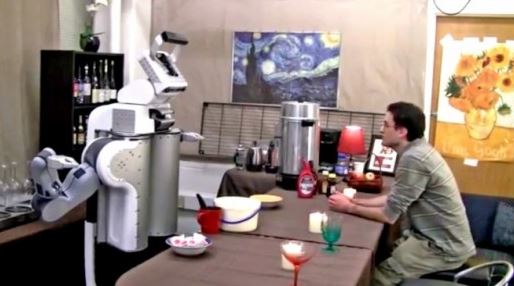
A new research project is focusing on doing just that. At Cornell University, a computer science team designed and built a learning robot as part of their “Tell me Dave” project. The Tell me Dave robot is based on Willow Garage’s PR2 robot, and was created from previous research that includes teaching robots to identify people’s activities by observing their movements, identifying objects and situations and responding based on previous experiences, and using visual and non-visual data to refine a robot’s understanding of objects.
Cornell’s Tell me Dave robot follows spoken instructions to learn new tasks. Image via Gizmag.
Equipped with a 3D camera and computer vision software, the Tell me Dave robot has been taught to associate objects with what they’re used for. Read More
Sure, a good phone case will protect your device from damage, but it can’t prevent debris such as sand, water, and grease from sneaking in there and wreaking havoc. The summer has just begun, and since your phone travels outdoors with you, you might want to keep these tips in mind in case your phone somehow winds up in a messy situation.
Sand
Let’s face it, the beach and your phone aren’t a good mix. It’s hard to see the screen in the bright sunlight, and worst of all, if you make one wrong move and your phone winds up on the ground, the sand will easily make its way into the cracks and crevices and can damage the inside of your phone.
If sand gets in your phone, make sure to turn it off before cleaning it, and use a small can of compressed air to blow the sand out of the phone’s most sensitive spots. If you don’t have a can of compressed air handy, a vacuum with a small crevice tool can do the trick. Read More



 Nicole DiGiose