Little Women Blackout poem

A blackout poem I created from a few pages of Louisa May Alcott’s novel, Little Women.

*

People, you know, envy girls fond of luxury

Man of the Sea learned to carry her without complaining

So light

Good spirits

Blue neck-ribbon, dressing her hair

looking nice, pretty or not

Bits of fun now and then Read More

Sweetie, Purchase My Valentine

A short article I wrote in my journalism class at SUNY Purchase on Valentine’s Day 2011.

The total spending for Valentine’s Day is expected to hit $15.7 billion this year, according to the National Retail Federation. On average, a person will spend over $116.21 on the holiday.

For SUNY Purchase students, there is quite a range on what they’ll do, and the amount of money they’ll spend on their sweetie, for Valentine’s Day.

“Tonight, my girlfriend and I are making pizza,” said Nick Sciretta, junior drama studies major. “It’s a cheap and fun dinner. We don’t need to go overboard. Spending time together is special enough.”

Phil Gallo, SUNY Purchase alum said, “I’ll probably spend about $75 on gifts for my girlfriend. Maybe a little more.”

Read More

I Learned to Let Go of What I was Used to

Below is my essay that was published on This I Believe.

Besides for my stuffed purple chick with one foot and a crooked beak, my brother Eric was my first best friend. My crib became his eleven months later, and eventually we shared a small room together. Our beds were so close, we’d jump from one to the other in our footed pajamas until my mom’s exhausted voice shouted up the stairs to lie in the beds and not jump on them.

Everyone outside of our family assumed that we were twins.  I’d always point out that I was taller. Aside from my longer hair, that was the only difference. We had the same chocolate eyes and the same shade of brown for hair; we’d make the same facial expressions—usually silly ones.

I would moan and complain and curl up on the couch when I had what my parents called “growing pains” in my legs. When it came to Eric, he would giggle, run to the refrigerator, and try to figure out how big the gap was between his head and the freezer door. There was never a reason for it, besides the fact that it excited us, but my father would take out his measuring tape and tell us how many more inches we had to grow until our heads reached the freezer door. I’d chase after my brother just to make sure I still had height on him. Read More

Raising Cane

A feature interview I covered for SUNY Purchase’s literary and arts magazine, The Submission Magazine, in April 2011.

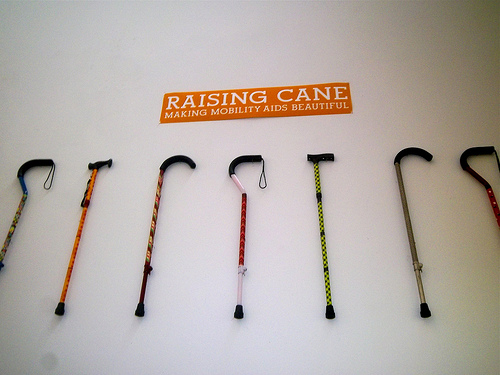
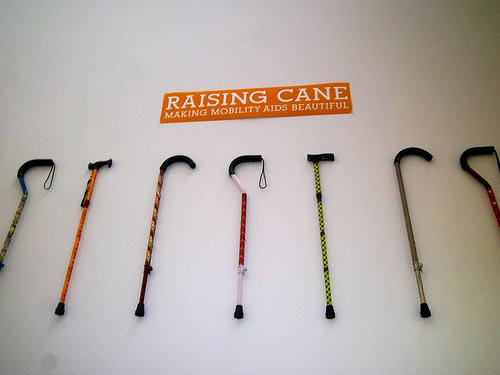
A row of eye-catching canes hanging across the open closet are revealed as the brown apartment door opens. They’re vibrant oranges, blues, purples, and greens, each in different patterns and sizes. From behind the door peeks senior graphic design major, Nicole Wynn, with her hair pulled back and glasses half way down her nose. After shutting the door, she walks by the collection of canes and heads for the living room.

She jokes that she took over the “messy” room as she looks around at the patterned canes and walkers up against the walls. A wheelchair is between the two couches. It was once black, but is now covered in an abstract design of the sun, its rays bursting. In total, there are 40 fashionable medical aids, most of them being canes that Wynn has designed for her senior project, along with a self-published book about her collection titled, Raising Cane.

Raising_Cane

Since birth, Wynn has been living with Multiple Hereditary Exostoses (MHE), a rare genetic condition causing multiple bony lumps and tumors to grow on all of the long bones of her body, most of the bones being irregularly shaped. According to Wynn, one in 100,000 people suffer from the condition, which comes with lots of pain and fatigue.

“The main reason I walk with a cane is because I have no hip sockets,” Wynn says. Instead, she has tumors growing in there. Read More

Disasters in Japan Affect Purchase Students

The tsunami that slammed northeastern Japan missed Purchase senior Kevin Cai’s home in Tokyo, but the 8.9 magnitude earthquake did not.

“The earthquake split the house in half and destroyed almost everything inside,” the arts management major said in an email. “It was my mom’s birthday so my dad had taken her out. Thank god they weren’t home.”

Over the last century, Japan has experienced 23 earthquakes that have caused major damage, according to Web-Japan.org. Estimates of magnitude make the earthquake of March 11 the largest earthquake to hit Japan and among the top five largest earthquakes in the world. 

The quake that destroyed northeastern Japan sent shock waves more than 6,000 miles away, as students and faculty at Purchase College dealt with the tragedy in varying degrees. Some, like Cai, lost homes. For others who had lived in Japan, the disaster brought up memories of past earthquakes. Read More

SUNY Purchase: Chess Club

An article I wrote for The Purchase Independent.

During the Chess Club’s most recent meeting, more students showed than at any other meeting since it started. Twelve students took turns sitting across from each other, filling the two large tables, eyes scanning the chessboard for the next move.

“There are usually eight people who come every week, but there are about 15 members in the club,” said Chess Club president, Julian Norton, junior graphic design major.

Chess’s popularity is rising across the country. According to the U.S. Chess Federation, there are nearly 2,000 USCF-affiliated chess clubs and more than 100,000 chess players that participate in the USCF events every year.

Norton presented the Chess Club idea to Ricky Gunzel, coordinator of Clubs, Organizations and Services, last semester. Chess Club passed the vote and it was given an initial budget of $50. Read More

Live On

My mother would scrunch her nose and her forehead would crinkle. Her blue eyes would slant and her barely visible eyebrows would almost touch. “I don’t like fish,” she’d say as she’d either push the plate away if my grandfather placed it in front of her, or wave her hand in front of her nose and back away as he opened the oven with his navy blue mittens.

*

“You ready for some swordfish, Casey?” my grandfather raised his voice above the hum of the stove’s fan. He had his eyes on the fish as he carefully placed it on the long plate on the counter. He removed the mittens and grabbed bottles of green seasonings to cover the peach flesh with.

He pointed his sweaty nose to the kitchen table as he made his way over with the dish.

I clutched the back of the kitchen chair that I always sat at (it used to be my mother’s spot at the table when she was a kid) and shook my head no. My hair flopped back and forth over my shoulders and I bit my bottom lip with my buck teeth.

“No? What do you mean, no?” My grandfather looked at me, eyes squinted. “This is good fish. It’s home cooked. I thought you liked it.”

“I’m not hungry.” I looked at the blue tiles on the kitchen floor. Little particles of dirt clogged the once white cracks.

My grandfather eyed my face, but I pretended not to notice. Read More

Eavesdropping

Last semester, one of my fiction professors assigned the class an eavesdropping assignment. That night, I was reading in the library when an unhappy couple caught my attention.

I raised my head from my book as I heard feet shuffle across the carpet. It was just about midnight, and I hadn’t seen any other students in the library’s basement. I sat cross-legged on a chair, one elbow leaning on the round table, the other on the corner of my open book.

A sigh came from between two shelves. “I can’t believe this.”

A short guy with black hair shook his head as he looked up. He held a cup of coffee in each hand and his jeans swished around his sneakers. He tucked his chin downward to sip from one of the white cups as he headed to one of the fluorescent-lit study carrels.

He gently kicked the green door, and it squeaked and swung back into a blue chair that was in the way. Next to the chair was another chair, where a girl with puffy chestnut hair in a dark sweatshirt and blue pajama pants sat. She slouched across from her laptop that was surrounded by packets of paper and a notebook.

“You’re so lazy. I can’t believe you couldn’t get your own coffee,” the guy said as he handed her one of the white cups. “You made me go all the way to Starbucks and come back here. You’re so lazy.” Read More

Unclipped

You’d think my Aunt Ebba would own a cat. One of those fluffy Persians that could sit on her lap as she stroked its fur with her scarlet finger nails. But no, she owned an obnoxious cockatiel named Pikachu.

Aunt Ebba loved to talk—she spoke three languages. So did Pikachu. He was all that she had left in her maze of a Victorian house. They’d watch Spanish soap operas together; Pikachu would recite French poetry as he stood on her shoulder, nuzzled up against her chin. It was astonishing, but quite sad. Aunt Ebba was lonely.

She hadn’t worked since her job at the florist as a teenager. After that, she went to college to study literature, but no career came from it. She married straight out of college, into a wealthy family. Her first husband was my Uncle Ty. He was a stock broker from New York. Aunt Ebba was in love with him; she gave up everything for him. She moved from her close-knit family in Jamestown, Rhode Island to live with him in his luxury apartment in Manhattan. He led a stressful life, and died young of heart failure. They had one son, my older cousin, Winthrop.

After Uncle Ty died, Aunt Ebba was depressed. She wouldn’t eat, she couldn’t sleep. She’d call my father, her brother, and cry to him on the phone about how she saw Ty in her dreams, and how she thought he was leaving her “signs from the other side” wherever she went.  She’d talk about how Winthrop looked so much like him, with his curly hair and small lips. My father would twist the phone’s cord as he gently spoke, and glance over at me and my mother, who stood behind me, hands on my shoulders. She would take me into another room when my father was on the phone with Aunt Ebba. I was a little girl then, and the sad tone in my father’s voice would upset me. My mother, with her teal watery eyes, would take my wrist and lead me away.

“Aunt Ebba has that really bad cold again, Liliane. Daddy needs to talk to her to cheer her up,” she’d say as she squatted down in front of me to stroke my hair when I asked why my father was unhappy. Read More