RFID tags are talking, and they’re talking about you

An article I wrote for Electronic Products.

Because RFID technologies will know all about your spending habits (if they already don’t), making a trip to the store can be quick and easy

Whenever the radio-frequency identification (RFID) industry is able to lower the price of tags, stores will be stocked with networks of smart packages that can track every phase of the supply chain. Shelves will be filled with smart-labeled products that can be tracked from the second you make your purchase to the moment the product hits the trash can.

Used for identifying and tracking items, an RFID system, which is made up of a small memory-storage chip (tag), is usually placed on the bottom of an item. RFID emitters send out radio waves to detect tags and read their stored data, which can range from a small serial number to several pages.

RFID Tag

An RFID tag. Image via news.softpedia.com.

Though RFID may not be everywhere, things are quickly heading in that direction. When you walk into the local grocery store to do your weekly shopping, some of the products you regularly purchase may already be tracking your spending habits. Read More

Meet Kevin O’Brien—He’s More Than Your Ordinary Bartender

An article I wrote for the October issue of Chilled Magazine.

After recovering from his lung transplant in 2007, Kevin O’Brien had no intention of returning to bartending. It wasn’t that living with cystic fibrosis, a life-threatening disease that causes thick, sticky mucus to build up in the lungs and digestive tract, held him down, he was just focused on succeeding in radio broadcasting. After all, he had his BA in Mass Communications and back then, bartending was just a side job.

It wasn’t until 2010 when O’Brien got back behind the bar, after his cousin, a manager at Kodiak’s Restaurant and Bar in Farmingdale, New York was in need of an experienced bartender.

“He got me a spot there and I realized how little I knew and began learning more about mixology, craft beer, and hospitality,” O’Brien said. “After a year at Kodiak’s I decided to stop working in radio and commit to learning more about the bar business.”

Image

According to O’Brien, living with cystic fibrosis makes what he wants to do all the more special. Before his surgery in 2007, he would go to work as a bartender with his oxygen tank even when his lung function was plummeting below 10%. Read More

Biometric Touchscreen Recognizes Your Fingerprints

An article I wrote for Electronic Products.

The first touchscreen to recognize you by your fingerprints may change the way you interact with computers in public places

Going to the café to sip on some coffee while getting a bit of work done on your laptop may soon become even more convenient. Winding down with nothing but some fresh brew and a fingerprint-identifying touchscreen display on the table in front of you may not be so far-fetched.

Current touch displays cannot scan fingerprints and fingerprint sensors cannot display images, but according to researchers Christian Holz and Patrick Baudisch of the Hasso Plattner Institute in Germany, what they invented does both.

Touchscreen Tabletop

Future coffee shops may be equipped with interactive touchscreen tabletops. Image via New Scientist.

Read More

Light Up Your Life with Video-Game-Inspired Lamp

An article I wrote for Electronic Products.

Add some 8-bit magic to your home with the touch-activated, sound-emitting Question Block Lamp

Remember the good old days of playing video games for countless hours without a care in the world? When making money meant hitting boxes with your fist and defeating Bowser to save Princess Peach made you feel accomplished? Now you can bring a piece of your childhood to life with the timeless symbol of your glory days with the Question Block Lamp by 8-Bit Lit.

Turn the touch-activated light on with your hand or head (if you’re real serious) and watch as it illuminates the room with the sound of a coin reward that will transport you back to the times of 8-bit gameplay. Energy efficient LEDs and retro graphics will add the familiar glow to any space, day or night.

8-Bit Lit Rooms

Any room looks good with a Question Block Lamp! Image courtesy of Kickstarter.

Read More

Will You Lose Your Job to a Robot?

An article I wrote for Electronic Products.

Robots are threatening to take over human jobs, increasing the percentage of unemployment in America

As if finding and keeping a job isn’t hard enough these days, in the near future all of your skills and years of experience may be lost to a robot. It’s hard to believe, but by the end of this century, it’s predicted that about 70% of today’s occupations will likely be replaced by automation. Robots are already analyzing documents, working long days on farms and assisting the staff of busy hospitals, and they’re doing it all for free. Read on below to see if your job could possibly be endangered by artificial intelligence.

Pharmacists
Don’t be surprised if a robot comes to the desk next time you visit the local drug store to pick up your prescription. In some pharmacies, such as the UCSF Medical Center, robots are already working behind the shelves, counting, preparing, and tracking medications. With robots taking care of processing prescriptions, UCSF pharmacists and nurses are able to focus their expertise on direct patient care. The goal of the automated hospital pharmacy is to improve patient safety, and so far, out of the millions of doses of medication that have been prepared, not a single error has occurred. The future looks promising for these robo-pharmacists.

UCSF Robot

One of UCSF’s robot-pharmacists hard at work. Image via UCSF.

Read More

Flying Robot Drones Make Life Easier on the International Space Station

An article I wrote for Electronic Products.

Smart SPHERES, NASA’s free-flying robotic satellites, are built to assist astronauts during space exploration

Robots flying around in space seem more like fiction than reality, but recently NASA has been testing their free-flying robots called Smart SPHERES (Synchronized Position Hold, Engage, Reorient, Experimental Satellites) in the International Space Station (ISS).

Self-contained with power, propulsion, computing, and navigation equipment, the purpose of these volleyball-sized spherical robots, which have been on the Space Station since 2006, is to perform simple, routine tasks on the ISS, such as in-flight maintenance to keep the Space Station safe and habitable for humans. To receive more information from the inside of the ISS from Earth, NASA’s Intelligent Robotics Group added an expansion port to each satellite for usage of additional sensors and appendages, such as cameras and wireless transfer systems.

SPHERES

The SPHERES have been on the Space Station since 2006 and were originally developed by the Massachusetts Institute of Technology through the Defense Advanced Research Projects Agency and NASA Small Business Innovation Research funding. Image via universetoday.com.

To transform the SPHERES into Smart SPHERES, project engineers at NASA equipped the free-flying satellites with an Android phone, the Nexus S, to function as the brains of the flying robots. By connecting a smartphone, the SPHERES immediately became more intelligent and automatically had a built-in camera to take pictures and videos, sensors to help with conducting inspections, a powerful computing unit for calculations, and a Wi-Fi connection that can be used to transfer data in real time to the ISS and Mission Control. The Nexus S was chosen because it’s easy to take apart and simple to program.  Read More

Life-Like Animal Robots Take on Important Jobs

An article I wrote for Electronic Products.

A look at some of the most fascinating robots inspired by nature

Surveillance camera hummingbirds, huge robo-mules marching off to war, life-saving cyborg cockroaches. It’s not science fiction; it’s the beginning of what seems to be a whole new world. Take a look at some of the most amazing animal influenced robots that are set to take on the land, oceans, and skies for some very important reasons.

Plant-pollinating RoboBee

It’s summertime again, meaning all of those pesky insects are back in action. But this year brings a new breed of bug flying through the skies: robotic bees. As the bee population has been drastically declining, a team at Harvard University’s School of Engineering and Applied Sciences began looking for an artificial alternative to pollinate plants. Their solution was RoboBee, a robotic buzzing bumble with the ability to travel in large swarms, assisting humans in agricultural production and exploring hazardous environments. The team has been working on sensors that can inform the robot similar to the way a bee’s antennae and eyes do.

RoboBee

Swarms of RoboBees may someday be used to pollinate plants. Image via gizmag.com.

Pollution sensing robotic fish 

Swimming swiftly through the ocean just like an actual fish, this self-guided robot may be the best weapon in the fight against pollution. Created by computer scientists at the University of Essex in England, it uses built-in sensors and artificial intelligence to make its way around underwater obstacles and respond to environmental changes. The fish can detect leaks in oil pipelines and explore the sea floor, feeding the information back to shore. Its micro-electrode arrays can detect lead, copper, and other pollutants, as well as water salinity and oxygen levels. It’s able to glide through the water for up to eight hours on a single charge before being recovered by boat.

Pollution Sensing Fish

The pollution-sensing robotic fish looks and swims just like an actual fish. Image via natgeo.com.

Read More

The History of the Harvey Wallbanger

An article I wrote for Chilled Magazine.

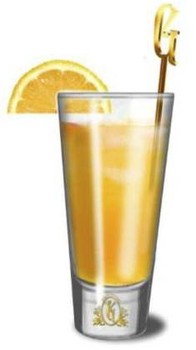
No matter how many you have, you’ll never forget the Harvey Wallbanger. With one of the most memorable names, this drink has made quite the splash in cocktail history.

According to mixology mythology, this classic was named after a surfer in the 1950s. After losing out on a surfing competition in California, the saddened surfer, Tom Harvey, swung by a bar he often frequented and ordered his favorite mixed drink: orange juice and vodka laced with Galliano. As he downed glasses upon glasses of his favorite concoction, he banged his head against the wall out of frustration from the loss. From that day on, his beloved drink became known as the Harvey Wallbanger.

The Harvey Wallbanger cocktail. Image via examiner.com.

The Harvey Wallbanger cocktail. Image via examiner.com.

Longstanding legend has it that the bartender who first mixed the soothing cocktail was Donato “Duke” Antone, who ran Duke’s Blackwatch Bar on Sunset Boulevard in Hollywood in 1952. Antone was known to be a topnotch bartender, but the Wallbanger didn’t become popular until the early 1970s. This was because of George Bednar, the marketing director of McKesson Imports Co., an importing company that handled Galliano, who found out about the cocktail and its story and advertised it as a replacement for the Bloody Mary during brunch. Late in 1969, the sandal-wearing, stressed-looking cartoon Harvey Wallbanger mascot was born, and his famous line was, “Harvey Wallbanger is the name and I can be made!” Read More

Five 3D-Printed Objects That Will Blow Your Mind

An article I wrote for Electronic Products.

With a 3D printer and some imagination, you can create just about anything

Though 3D printers are still too expensive to make their way across the globe into our homes next to our tablets and flat-screen TVs, the few lucky early adopters who got their hands on them have created extraordinary three-dimensional objects. While 3D-printed clothing and toys are impressive, below are some mind-blowing creations that prove 3D-printers are totally worth it.

3D-printed self-assembling robot

The future is coming, and it’s coming fast. By now, we’ve already heard about robots that can assemble themselves, but a 3D-printed robot that can do the same is ridiculously impressive. The innocent-looking inchworm robot pictured below was created by researchers from Harvard and MIT, and it has no problem assembling itself to inch about. The only human intervention was attaching the robot’s motor and battery. The next step will be a more complicated robot that builds itself and walks away, and it will come pre-assembled with a battery and motor. All we have to do now is wait for the day when robots become smart enough to print themselves out.

3D Printed Robot

MIT and Harvard’s 3D-printed inchworm robot can assemble itself. Image via inhabitat.com.

Read More

Working Out on the International Space Station

An article I wrote for Electronic Products.

A look at how astronauts stay in shape in space

Here on Earth, we’re constantly using certain muscles to support ourselves against the force of gravity. But for astronauts on manned missions, the absence of gravity aboard a spacecraft makes moving physically undemanding.

Because astronauts work in a weightless environment, little muscle contraction is needed to support their bodies. Without regular exercise, muscles such as the calves, quadriceps, and those in the back and neck can weaken and deteriorate. The loss of physical strength can be extremely dangerous, especially if an astronaut must perform an emergency procedure while re-entering the Earth’s gravitational field. Studies have shown that astronauts experience up to a 20% loss of muscle mass on spaceflights lasting five to 11 days. So while working gravity-free in space, what do they do to keep their muscles from deteriorating?

Astronauts aboard the International Space Station (ISS) exercise, and they do so intensively for two and a half hours a day. There’s exercise equipment aboard the ISS, and each machine has different uses to combat the many effects of muscle atrophy.

The Advanced Resistive Exercise Device (ARED) maintains muscle strength and mass in astronauts during long periods in space. It uses adjustable resistance piston-driven vacuum cylinders and a flywheel system to simulate free-weight exercises in normal gravity. Without workouts like the ones possible on the ARED, astronauts are at risk of losing up to 15% of their muscle volume, which is difficult, or even impossible, to regain back on Earth. The ARED can exercise all major muscle groups while focusing on squats, dead lifts, and calf rises. This device provides up to 600 pounds and has a touchscreen to make it easy for crewmembers to follow a personalized plan.

ARED

ARED maintains muscle strength and mass in astronauts during long periods in space.

Read More